
When you need to find a plumber, a mechanic, or someone to prune your elm tree, what do you do?
Back in the day — and I say the day, not my day, because I don’t want to sound like I lived through the Dust Bowl — we had a couple of reliable options for sourcing services we needed:
- The Yellow Pages
- Family, friends, and neighbors
The Yellow Pages have gone the way of juke boxes and riding in the back of a station wagon without seat belts, but thankfully the second option still exists.
In place of the first option, we now have the internet. Yet despite the plethora of resources and the lightning speed at which you can get answers on the internet, it strikes me that it’s not any better than The Yellow Pages. In fact, it sometimes feels worse.
I happened to be browsing Facebook today for any interesting free items in my Buy Nothing groups and I saw a post asking for recommendations for mechanics:
Hey everyone! Does anyone have any mechanic recs? Everyone I’ve found either can’t do the issues my car needs (fixing AC, door doesn’t lock, transmission problems) or they are way overcharging. I have no problem paying a fair price for any service but the quotes I’ve been receiving are definitely overpriced. Thank you!
Before I get into the answer portion of our show, I should mention that I had some issues with the request itself. First, they’re saying the places they’ve found don’t do… regular mechanic stuff? Who are they asking, a guy sitting outside Home Depot? A bakery? Second, on what are they basing their claims of overcharging? It’s like the computer acronym GIGO, which stands for “Garbage in, garbage out.” I think leaving it at, “Hey everyone! Does anyone have any mechanic recs?” would have sufficed.
A small digression, but relevant as we’ll see.
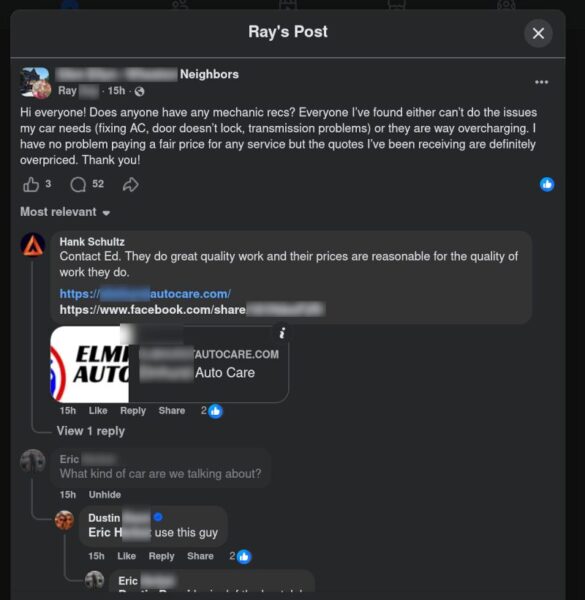
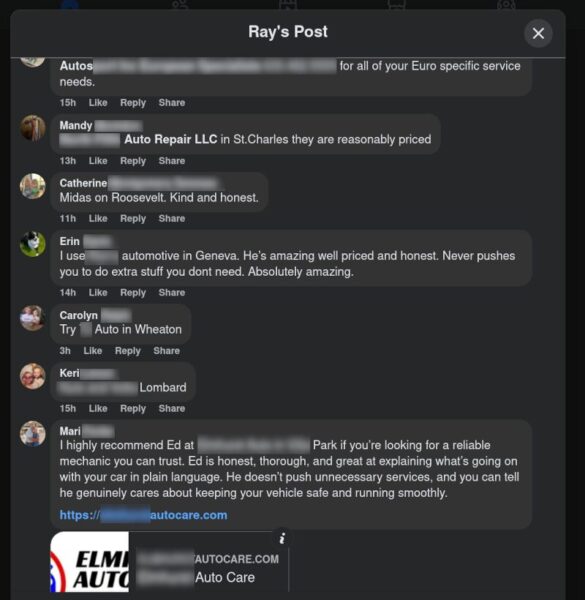
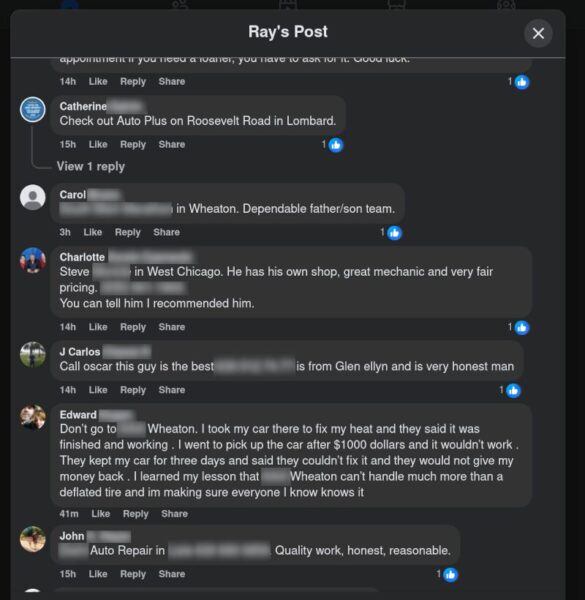
A flood of answers came back, which speaks to either the willingness of the community to help out — or their boredom on a Saturday. Maybe it’s both. On one level, people want to shout out the services they’ve used and loved, which is natural and a good thing. Most people want to be helpful. The fact that this platform exists where you can crowd source answers and get real people responding in mere minutes is an incredible thing — like sliced bread, you might say.
The quantity of answers is no doubt amazing. It’s the quality that left me scratching my noggin. Essentially, this person now has a very long list of just about every mechanic in the local vicinity, and every one is some form of “amazing” or “the best.” What do they do with this glut of information?
It reminds me of Yelp or Google reviews. Humor me and try this:
- Go to Google Maps or Yelp and search for a type of business, like “auto mechanic.”
- Pick one in the list that appears, it doesn’t matter which one.
- Browse the reviews.
- Note the number of stars and skim a few.
- Repeat with another of the same type of business.
What did you find? Would you be able to choose a good one or a bad one just from reading the reviews? Maybe some have a long list of rave reviews, but many will also have a couple stinkers in there. Are the disgruntled people wrong or lying? Are the rave reviewers wrong or lying? How would you know? And what do you do with all that information?
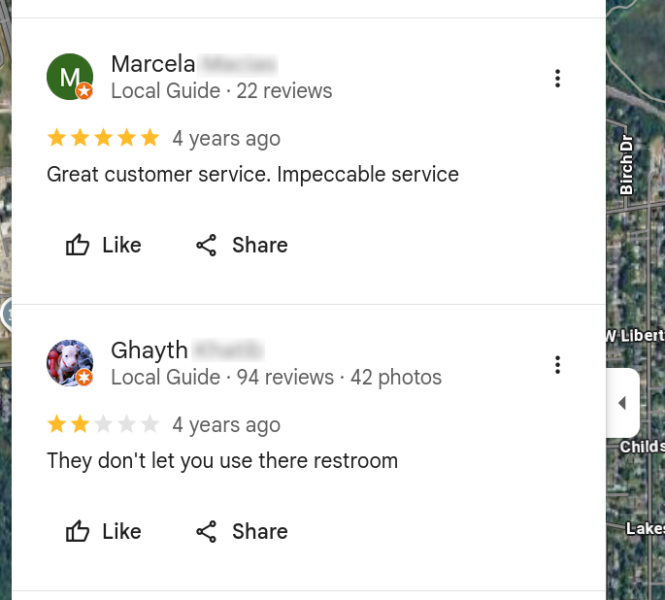
Then you have to sort through the reviewers who are probably disgruntled everywhere they go.
“They don’t let you use there (sic) restroom.”
“I don’t know what stellar customer service other reviewers have received because I did not get it.”
If you don’t know the reviewers personally, how can you analyze their scale of bad-to-great service? Sure, there are some businesses out there with so many 5-star reviews that it would be weird if you ignored them — or vice versa. Yet the saying “One person’s trash is another one’s treasure” comes to mind.
Remember The Yellow Pages? Imagine if it included printed reviews next to each business. First of all, you wouldn’t even be able to lift up the book, and it would probably remain on your doorstep until it became part of the house. But say you managed to get it inside onto a sturdy table. You flip to the mechanic section and find the first one — AAA1 Floyd’s Repair Shop. Great. It’s got a name, a phone number, an address, a cheesy tag line and a logo. Looks legit. But wait. Is it a good place? Back in the day, you would quickly find three or four of these places and call each of them to get a feel for how they answer the phone, can they do what you want, etc. But with the review-laden version of The Yellow Pages, you have to flip through twenty pages of reviews to find another listing. And while you’re flipping, a couple reviews catch your eye:
“Floyd is a genius! I was back on the road in 20 minutes! Great service and fair prices!”
“Avoid Floyd’s at all costs. My repair took forever, I lost a whole day of work. Floyd is also grumpy and wouldn’t give me the time of day. I paid way too much for that treatment.”
The rest of the reviews are a mix of the same. So now what? Are you back to square one, or do you still put Floyd’s on your list?
We have so much information at our literal fingertips. So much so that I can search the Chinese restaurant my wife and I used to visit in Germany in the ’90s, which is still in business. I can also read their reviews, and this one exemplifies the point I’m trying to make about reviews:
“I was hesitant to try this place because of some of the reviews, but I was satisfied with every single dish (and I’m a picky eater with high standards).”
“Picky eater with high standards” could simply mean that they enjoy bland, flavorless food, which many of the other reviewers claim to have had. And our experience (in 1993, anyway) was pretty great. So with all this information and much of it conflicting, what do we do? How do we find places we can trust to help us with what need?
We go back to people. And by “people,” I mean our friends, family, and neighbors. And you may be asking, How is that any different from polling a local Facebook group or jumping on Google Maps?
First, our friends, family, and neighbors have skin in the game. If they refer us to a place and our experience turns out to be horrible, they will be embarrassed at the very least. And we may not trust their suggestions in the future. So if a friend recommends someone, it’s probably good. Who wants to send a friend to a mechanic they think even has a chance of screwing up their car or being a jerk?
Second, we know these people — hopefully better than the randos on Facebook or Yelp. Knowing them, we likely have a sense for when they have a legitimate gripe against a service and when they might be leaning a little towards the dramatic. And on the flip side, we can usually read true enthusiasm on someone’s face. Mary’s new roof looks amazing and the work was done efficiently, so it’s a good bet that Mary’s roofing people are safe to use. Lucy’s 2012 Honda is still going strong, so trying out her mechanic is not a big risk.
The internet has made it fast and easy to find long lists of services in our area. It’s a pretty nifty system. But finding someone reliable, safe, and affordable takes more than just clicking some keys. It takes interacting with real humans in real life. That’s harder. It takes more time and more engagement. It’s work. But doing that work and investing in those relationships brings rewards that anonymously searching the internet can’t.
Word of mouth beats the internet every time.

Leave a Reply